
The relationship between a speller and communication regulation partner (CRP) involves a strange intimacy. We spellers need someone who believes in our intelligence and ability, whose energy is steady and encouraging, who is perceptive enough to pick up on how our bodies move and their tensions, who understands that pulling away may have several meanings, such as a momentary reset, distraction, or distancing in order to process, rather than retreat or dislike. We need a firm but gentle toughness, a commitment to assist us in keeping to task, to see past our occasional bad moods, through our bullshit, past our fears, or even, possibly, to understand our need to test your commitment and your respect for our efforts and capabilities. We need you to view us as equals, to be someone who will hold us accountable for upholding our end of the communication connection. Some of us may be like the fox in The Little Prince, needing a process of trust, for you to prove your commitment with evidence that you like and have faith in us, that you will patiently and dependably show up and not disappear without notice.
A large part of our relationship involves body regulation: easing us to relax so we can focus, observing when we need a moment or more to clear out excess energy with movement, easing us out of stress reactions, taking us through body patterns until they become ingrained. You act as another observer—along with our families, care staff, doctors, and therapy practitioners—as someone who aids this team by noticing differences in sight, hearing, and coordination that may have gone unnoticed (maybe for years) in the context of other activities or even types of communication. (Remember, we have been living in our bodies as they are and are unaware of ways they can operate differently. For example, I have hearing loss that has not been effectively measured and double vision from strabismus, which was not diagnosed until almost ten years ago and—even with corrective lenses and weekly therapy—still presents eye-focusing difficulties in overcoming an over-thirty-years habit of narrowing my field of vision to monocular, peripheral glances.) You can help us experiment with new accommodations as we discover new methods to move and perceive.
Sometimes we also need you as impromptu therapists, identifying internal or external factors that may trip us up or hold us back. More than this, we not only rely on your expertise in redirecting our focus toward concentration so we can regulate our wayward bodies, but we also benefit when you encourage us to develop and internalize these skills. Then we can recognize our personal forks in the road and increasingly learn to keep ourselves on track by calming our own nervous systems and redirecting our minds toward focused, constructive thinking and purposeful movement.
This is a lot to ask of you. We will reciprocate as we are able—sometimes subtly, sometimes overtly—expressing our deep-felt gratitude and friendship. You offer us freedom and access to our lives in a way few relationships ever will. We hope the connection you have with us, and which you assist us in establishing with others, will be stimulating and rewarding beyond the thrill of sharing communication milestones. We love that you are involving yourselves in the process of shifting paradigms about ability, neurodiversity, and inclusivity. We love that our families, friends, teachers, coworkers, researchers, doctors, legislators, and public at large are changed by the work you do with us to free our voices.
As in any working partnership, we will find some people easier to communicate with than others: the ease, breadth, and depth of our thoughts and words will vary from CRP to CRP. I have been spelling for 33 years and, at varying levels of fluency, have had in the neighborhood of 50 communication partners as school aides, support staff, infrequent or one-timers, friends, family, and (constantly, enduringly) my stepmom, with whom I am most fluent. Fluency involves liking someone, but does not necessarily indicate the degree of affection. Before he died, I loved my dad more than anyone, but his passionate energy was too intense, and he was someone whose brilliant mind and body ran at full speed, so I tended to rev up with him in the desire to spark our minds together. Neither of us was very patient with the slow process of tapping out words, letter by letter, but we could talk at length when my stepmom more calmly supported my typing and regulated us both with her presence. Sometimes we feel a partner’s own pain, tension, or agitation, or our own might interfere. Or we might feel giddily or goofily hyped by or attracted to a partner and have to establish the footing of our personal relationship before we can settle down and focus on working together.
As you can see, connection is essential to a communication partnership, but we have to acknowledge the many levels of connection that may be operating at one time, sometimes toward focus and sometimes away. It is a complex relationship we will share. Unique. Challenging. Delightful.
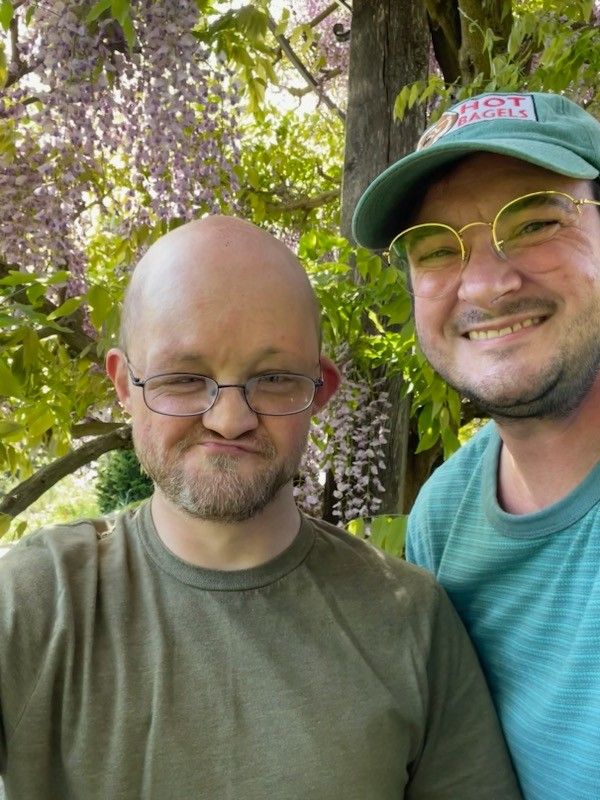
ABOUT NICK PENTZELL
Nick is the co-editor of Leo in Bloom Magazine. You can learn more about him here and here. Happy reading!
 Leo in Bloom Magazine
Leave a comment